Field Guide · Edition 058 Established 2024 · Skill-game desk

Rummy, read closely.

A working library of rulebooks, format ledgers and platform notes for adult players who would rather understand the table than guess at it. No jackpot framing, no fabricated payouts, no game-outcome promises — only the rules, the maths and the equipment.

Reading time · 18 min Verified by the editorial desk No real-money play on this site
Visual field guide

The reading table, framed.

Five photographs of a working rummy desk — cards, melds, declared hands — annotated the way an editor marks up a manuscript.

Plate I · Mosaic
Ranked insights

The eight rummy formats, ranked by adult usability.

A reading-room leaderboard. Each row pairs a format with a one-line rule summary and the equipment that changes the feel of the table.

Sortable · editorial ranking
  1. 01

    13-card Indian rummy

    Two decks plus printed jokers · 2–6 players · pure-sequence mandatory

    A pure sequence (no joker) is the floor of every valid declaration. Lose it and you score the full count of your ungrouped cards — typically 80. Most states regulate this format under the Public Gambling Act carve-outs for games of skill.
    5–8 min hands
  2. 02

    Pool rummy (101 & 201)

    Persistent pool · players eliminated at 101 / 201 points · fixed entry

    Pool tables turn every hand into a survival decision. The mathematics of pool are public: each player carries the cumulative cost of deadwood until they reach the elimination threshold and the seat is re-opened.
    1–4 hour tables
  3. 03

    Deals rummy

    Fixed number of deals · chip leader wins · no re-buys

    Each deal carries a fixed chip value assigned to first, second and last place. The ledger is the table — chips in front of each player at the end decide the night.
    3-deal · 6-deal
  4. 04

    21-card rummy

    Three decks · three jokers · three pure sequences required

    Three pure sequences (no joker) plus one more valid grouping is the modern declaration rule for the 21-card format. Some legacy clubs still run on the older two-sequence variant — confirm the rule sheet before play.
    Slower · 12 min
  5. 05

    Gin rummy (two-player)

    Single deck · 10-card hand · knock or gin

    Knocking with deadwood under 10 is the safe play; gin (zero deadwood) scores a bonus. The strategy split between lay-off and undercut is the cleanest two-player decision tree in the rummy family.
    10 min hands
  6. 06

    Rummy 500 (500 rum)

    Partner or solo · 500-point target · melds + bonus contracts

    Contract rummy layered on the 500-point target. Each deal you must pick up a specific meld type — sevens, runs of seven, seven of a kind. A reading-heavy format.
    Partner play
  7. 07

    Contract rummy

    Seven contracts · two jokers · escalating difficulty

    Contract one is two sets of three; contract seven is seven cards of one suit. The format is a slow burn — useful for family tables because every player sees the same contracts and no money sits on the side.
    Family friendly
  8. 08

    Indian marriage rummy

    Three decks · wild jokers · marriage sets (king–queen)

    The marriage grouping — a king and queen of the same suit — pays an extra bonus. Some clubs still play a "tunnel" variant where the same card counts in two groupings. Read the rule sheet.
    Regional · verify
Split-axis stories

Two dossiers: rule sheet versus strategy note.

The same hand of cards, read two ways. One as a printed rulebook, one as a probability notebook. Both are honest. Neither promises a win.

Dossier I & II
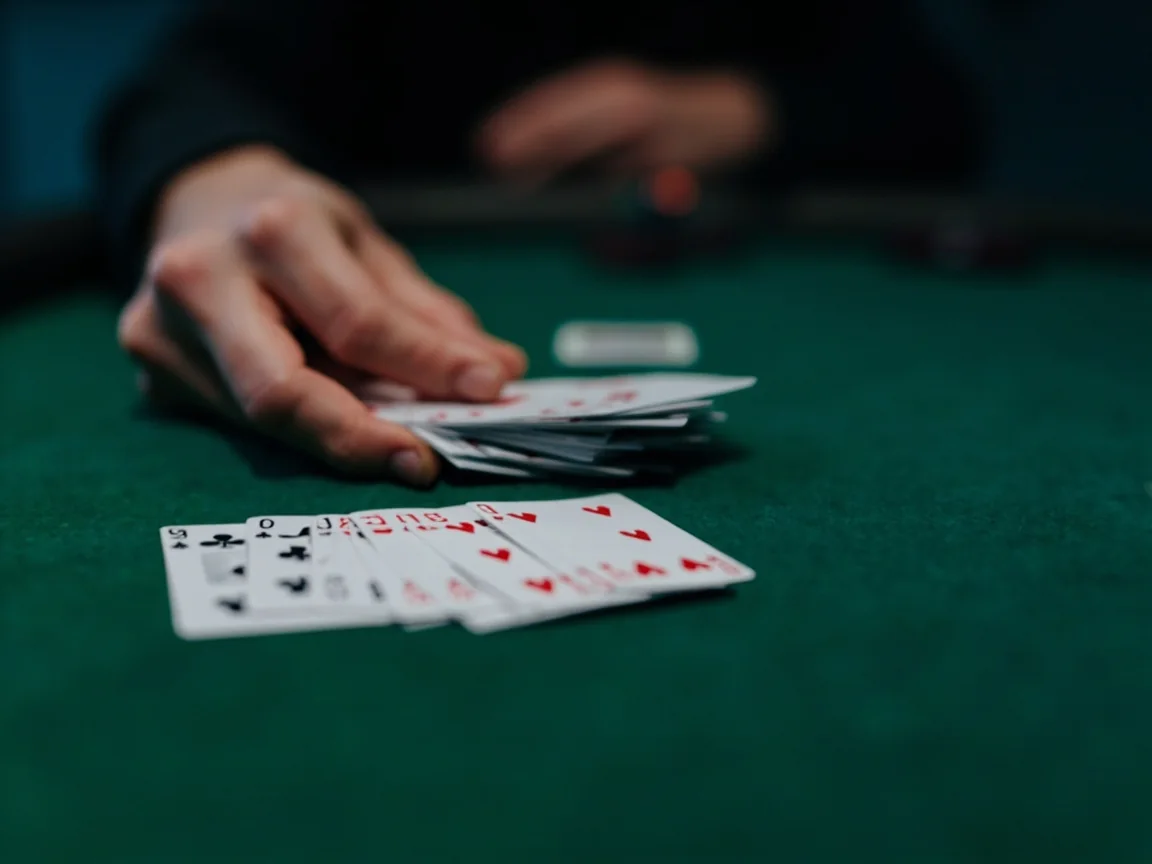
Hands dealing 13 cards to players around a rummy table in a card room.
Plate 06 · The dealing stepI

The first minute of the hand is the dealing step.

Thirteen cards each, face-down, distributed clockwise. The balance of the deck becomes the closed stock; the top card is turned face-up to start the open discard pile. The player to the right of the dealer either picks the open card or draws blind — that single decision is the entire opening gambit of the hand.

Most digital platforms now automate this step, but the underlying rule is the same: the dealing player always finishes last. A printed rule sheet on the table helps new players catch up.

"A pure sequence is the floor; everything else is decoration until you have it."

Read the full how-to-play guide ›

Close-up of cards fanned out for analysis with a magnifying glass and paper notes.
Plate 07 · Reading the discard pileII

Reading the open pile is half the table.

Every card a player chooses to discard is a public signal: the rank and suit they have given up on. Over the first six or seven turns, the open pile is a partial map of every opponent's hand. A strategy note is simply the act of writing that map down before you draw.

Two cards of the same rank discarded in the first three turns is an unusual pattern — most players hold pairs and wait for the joker. A discarded 7 of hearts after a discarded 7 of spades is a stronger signal still: your opponent cannot make a run with that card.

"The pile never lies. The pile just speaks quietly."

Open the strategy notebook ›
Reference ledger

Rummy at a glance.

A single table covering formats, decks, declaration rules, average hand length and minimum adult age. Use it as the cover sheet of the rulebook.

Plate III · Ledger
Field comparison · rummy formats and equipment
FormatDecksPlayersDeclaration ruleAverage handMin age
13-card rummy2 + jokers2–61 pure sequence + 1 group + 1 finish5–8 min18+
Pool rummy (101)2 + jokers2–6Same as 13-card · elimination at 1015–8 min18+
Pool rummy (201)2 + jokers2–6Same as 13-card · elimination at 2015–8 min18+
Deals rummy2 + jokers2–6Chip-ledger wins after fixed deals3-deal / 6-deal18+
21-card rummy3 + 3 jokers2–63 pure sequences + 1 finish10–14 min18+
Gin rummy12Knock under 10 · gin scores bonus10 min18+
Rummy 50022–4 or teamsReach 500 · contract melds30–60 min18+
Contract rummy2 + 2 jokers3–8Seven escalating contracts90 minFamily
Marriage rummy3 + wild jokers3–6Marriage K-Q set + valid finish10–12 min18+

Rule summaries above reflect the most widely-printed rulebook variants. Always confirm the rule sheet on the night — regional clubs print small variations.

Questions desk

Twelve questions adult readers actually ask.

Answered the way an editor would, not the way a marketing page would. Plain language. No "play now" framing.

Filed by the editorial desk
Q.01

Is 13-card rummy a game of skill or chance?

Under Indian Supreme Court precedent — most recently reaffirmed in judgments on rummy operators — 13-card rummy is treated as a game of skill where the dominant factor is mathematical judgement, discard reading and memory. Different state Public Gambling Acts treat the cash variants differently; this is a regulatory question, not a mechanical one. See the Is rummy legal? page.

Q.02

What is the minimum hand I need to declare?

One pure sequence (a run with no joker), one more valid grouping (a run or a set), and one leftover card that fits somewhere. Most printed rule sheets also require that the total count of your hand reaches zero after grouping. Until the pure sequence exists, no declaration is valid.

Q.03

How is the joker used?

One card per deck is picked at random as the printed joker. A wild joker is the card of the same rank and any suit (e.g. if the printed joker is the 7 of hearts, all four 7s are wild). A wild joker substitutes for any card you need to complete a set or sequence, but never counts as a pure-sequence card.

Q.04

What is the difference between pool rummy and deals rummy?

In pool rummy, players sit at the same table across many hands and the goal is to stay under the elimination threshold (101 or 201 points). In deals rummy, the table plays a fixed number of deals and the chip-counted winner takes the night. The strategic reading is different: pool rewards survival, deals rewards reading a small number of opponents closely.

Q.05

Do I need a special deck?

Two standard 52-card decks shuffled together with one or two printed jokers is the common equipment for 13-card Indian rummy. 21-card rummy uses three decks. Gin rummy uses a single deck. Most platforms ship digital decks that match a printed rule sheet, but the physical equipment is cheap and worth owning for home tables.

Q.06

How long does a single hand take?

A 13-card hand with experienced players runs between five and eight minutes, including the dealing step. Pool tables compound this across many hands; one round of pool 101 may run 60–90 minutes with a full table. A 21-card hand sits closer to twelve minutes.

Q.07

What is a "show" or "declare"?

A declare (sometimes "show") is the act of pushing your final card to the discard pile and laying your 13 cards face-up in valid groupings. Once declared, the table verifies the groupings. An invalid declare scores the full count of ungrouped cards — typically 80 — and the hand ends.

Q.08

Can I play rummy alone to learn?

Single-deck formats like gin rummy have long supported two-player study, but most rulebooks assume a table. Some platforms offer single-player training against bots — useful for memorising card combinations and declaration patterns. The strategy desk covers training routines.

Q.09

What does "deadwood" mean?

Deadwood is the count of ungrouped cards left in your hand at the moment of declaration. In gin rummy, knocking with deadwood under 10 is the standard play. In Indian rummy, deadwood is the count you owe the table on an invalid show.

Q.10

What is the safest way to set time and money limits?

Set a hard time limit before the table opens, write it down on a piece of paper, and let one person at the table track it for everyone. The same paper should hold a hard money limit if money is on the table. See the responsible play desk for limit templates and warning signs.

Q.11

Are online platforms fair?

Reputable platforms publish their RNG certification and shuffle proofs (random-number generation logs verifiable by an independent auditor). Check the platform's responsible-play footer for an RNG certificate reference. If the certificate is missing or undated, treat it as a red flag — see the reviews desk.

Q.12

What age is appropriate?

Family formats such as contract rummy (no money) are appropriate for any age where cards are appropriate. Cash rummy and tournament rummy with entry fees are written for adult players and almost universally enforce 18+ on entry. If you are under 18, treat the rulebook as reading material, not as a playing invitation.

Next-step panel

Carry the field guide forward.

The home edition is one chapter. The full library lives behind the eight chapter links above.

  • Begin with Games if you want a rule-by-rule breakdown of every format.
  • Begin with How to Play if you have a deck in hand and want the dealing step now.
  • Begin with Responsible Play if money is on the table tonight.
Latest from the news desk

Three rule updates worth reading this week.

Filed in the past ten days. Each note opens with what changed, when, and where the rule sheet can be verified.

Close-up of an open rulebook with new revision stickers.
Rule update · 28 July

Wild-joker clause revised in two state rulebooks

A short note on how two state associations have aligned their printed joker rules with the All India Gaming Federation template.

Plate IXRead ›
Mature adult at a podium with a neutral backdrop, papers on podium.
Industry · 22 July

Online rummy platforms publish 2026 RNG audit summary

A round-up of which platforms published independent RNG audit reports in the first half of 2026 and what the auditor scope covers.

Plate XRead ›
Editorial shot of a rummy tournament hall, multiple tables in soft focus.
Tournament · 15 July

State-level rummy circuits release 2026–27 calendar

The major state-level circuits have published their 2026–27 calendar of invitational and open tournaments, with format and entry details.

Plate XIRead ›
From the journal

Long-form essays for the slow reader.

Three pieces from the editorial blog. Read with a cup of something warm and a deck at your side.

A wooden side table with a leather-bound probability reference book open, reading glasses on top.
Essay · 2,800 words

The mathematics of the open pile

Why the discard pile is a public ledger — and how to read it as carefully as a manuscript proof.

Long readRead ›
Two adults at a card table, one with a neutral expression reviewing their hand beside a stack of ivory chips.
Essay · 3,200 words

Reading your opponent's discard without staring

Field-tested etiquette for paying attention to the table without making the people at it uncomfortable.

Long readRead ›
A vintage desk clock on a stack of books near a window, soft natural light.
Essay · 2,500 words

How to set a table-time limit you will actually keep

A simple, paper-based routine for keeping time at the table without the conversation turning managerial.

Long readRead ›
Platform desk

Three platforms, one rulebook.

A reading-room comparison of how three mainstream platforms handle the rule sheet, the random-number generator, and the responsible-play controls. Editorial observations only — no platform rating.

Adult hand holding a phone showing a rummy app interface, wood desk background.
Mobile · 320–430 px

Mobile reading-room ergonomics

How readable a rummy app is in the smallest viewport — type sizing, card contrast, button placement.

MobileNotes ›
Tablet on a stand on a coffee table, rummy game interface visible.
Tablet

Tablet layouts and rulebook access

Why the tablet form factor is the cleanest place to keep a rule sheet open beside the table.

TabletNotes ›
Three devices side by side on a wooden desk showing a card-game interface.
Desktop

Desktop dashboards and ledger view

How desktop platforms surface the rule sheet, hand history and tournament results side by side.

DesktopNotes ›
Safety desk

Verification, payment and the rule sheet.

A practical guide to the documents, payment methods and platform controls that should be visible before the first hand is dealt. No guarantees — only the things to look for.

Step 01

Identity check

A PAN or Aadhaar verification step is standard. Confirm the platform's privacy footer before uploading.

Step 02

Wallet setup

Most platforms run on a wallet model. Check the deposit and withdrawal history ledger before any hand.

WalletRead ›
Step 03

Payment method

UPI, IMPS and net-banking are the common rails. Avoid any platform that asks for a card CVV on a public form.

PaymentRead ›
Step 04

Customer care

Look for an in-app support channel and an email address on the company footer — not just a form.

SupportRead ›
Responsible play shelf

Five rules every adult player can write down.

A short list, written so it can be pinned to the wall above the table. No moralising, no judgement — only the practical notes that the editorial desk would put on the inside cover of the rulebook.

01

Set a hard time limit before the table opens.

Write it on a piece of paper. Let one person at the table track it for everyone.

02

Decide the money limit before the first hand.

If it is a cash night, agree the cap in advance. Do not extend it after the table opens.

03

Take a break every forty-five minutes.

Stand up, refill the water glass, look out a window. The cards will still be there.

04

Do not play to recover a loss.

The table does not know what happened in the last hand. The cards do not owe you anything.

05

Stop playing if it stops being fun.

If a hand at the table feels like work, close the deck. There is no prize for staying.

06

Know where to get help.

A short list of support lines and resources lives on the help page.

Editorial pick Check today's sportsbook ›